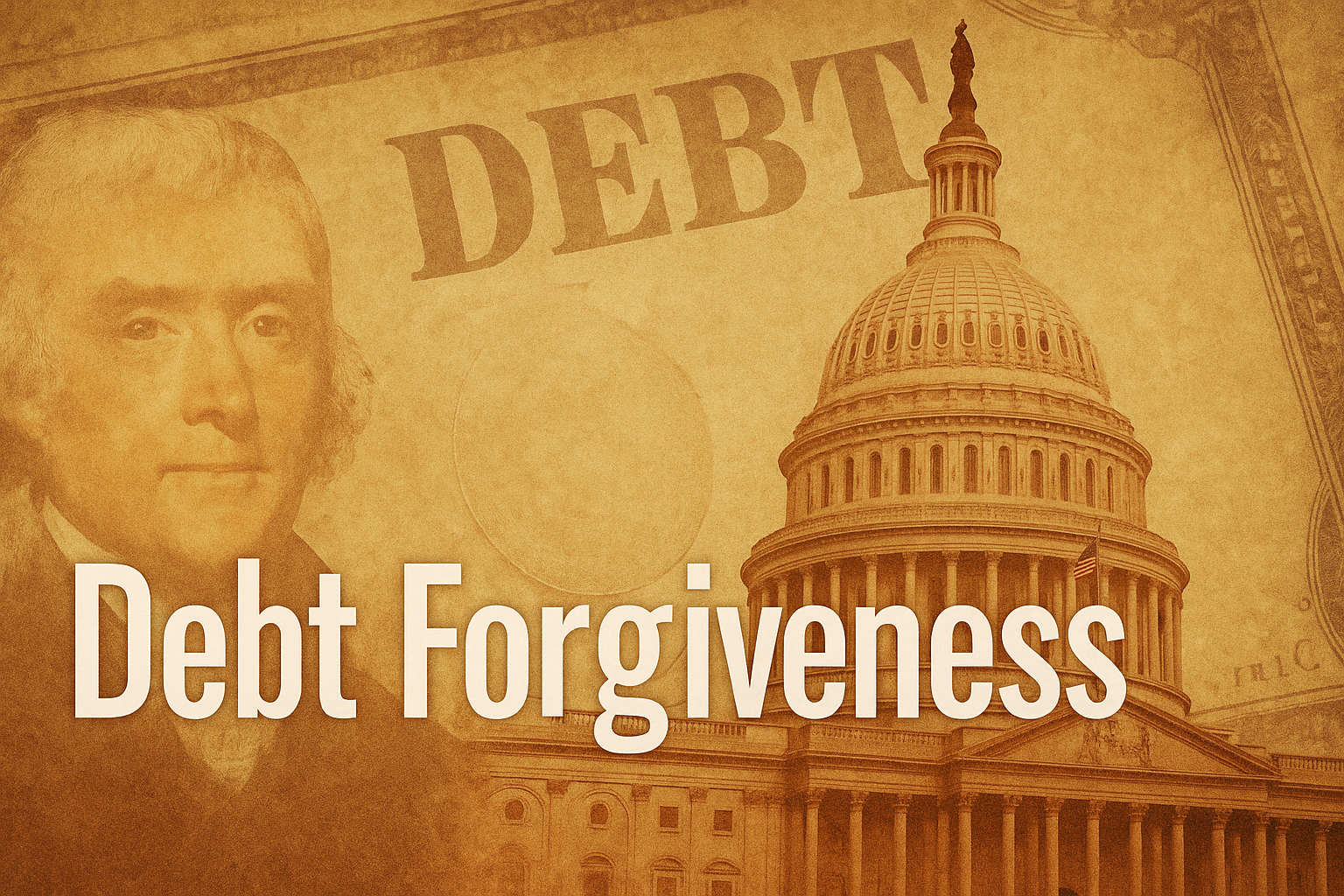
“Proclaim liberty throughout the land to all its inhabitants.” — Leviticus 25:10
TL;DR (for the watchmen)
- The modern U.S. economy runs on credit: bank lending creates most of the money supply, with interest claims that pressure the system toward perpetual expansion.
- Asset prices—especially houses—float on debt availability, not just on the cost of wood and labor, because appraisal standards key off comparables (sales of similar, debt-financed homes).
- Institutional buying of homes is rising: in 2021, investors purchased 24% of all U.S. single‑family home sales—up notably from 15–16% a decade earlier.
- The state taxes inflation in multiple ways (e.g., capital gains on nominal increases; bracket creep and unindexed thresholds).
- The biblical Jubilee is not a metaphor; it is a hard reset: release of debts, return of land, rest for the land. America is at its 250th year—five cycles of fifty. The choice is the same as ancient Israel’s: obey reset or face judgment.
1) Debt as the Operating System
In the U.S., commercial banks don’t merely shuffle existing savings to borrowers; they create new deposit money when they extend loans. That means the money supply expands with credit—and the system must either keep rolling over and expanding debt or absorb painful contractions when credit tightens (Bank of England, Money creation in the modern economy, 2014).
This doesn’t mean there isn’t enough money to pay interest in a strict accounting sense—money recirculates—but it does mean the system prefers growth to avoid cascading defaults. When growth stalls, policymakers lean on monetary easing and fiscal deficits to re-inflate the cycle.
A pivotal turn was August 15, 1971, when President Nixon ended dollar convertibility to gold, removing the last restraint on fiat expansion. Since then, the world has lived under floating currencies and recurring credit booms and busts.
2) Why Houses Don’t Price on Lumber Alone
If houses were priced by materials and labor (the cost approach), a pay-as-you-go buyer could compete evenly with a highly leveraged one. But the dominant standard for residential valuation is the sales comparison approach—what similar properties actually sold for, usually with mortgages. Lenders and the GSEs (Fannie Mae/Freddie Mac) require closed comparables to support value (see Fannie Mae Selling Guide, Appraisal Requirements).
When credit is loose, comps rise—and appraisals chase them up. When credit tightens, comps stall or fall—and appraisals follow. Either way, debt availability is the invisible hand behind “market value.”
3) Who Owns the Roof Over Your Head?
Until the loan is paid, the bank holds a senior claim (the lien). Miss enough payments and the claim wins. Functionally, equity is a junior slice of ownership with downside risk.
If you’re 40 and start a 30-year mortgage, you’ll be 70 at payoff—if nothing interrupts income, health, or interest rates. Skip the buy? You miss the inflation “asset ladder” when the next credit wave lifts nominal prices. Either path traps households in the credit-asset treadmill: borrow to buy the asset, then hope the next inflation round bails you out.
Meanwhile, in many cities investors are gaining share of purchases, concentrating ownership and pushing families into permanent renter status. Some metros now see one-fifth to one-quarter of purchases by investors, with even higher shares in targeted neighborhoods (CBS News; Pew Charitable Trusts, 2022).
4) “The Banks and Corporations Own Everything”—What Jefferson Did (and Didn’t) Say
A popular meme attributes to Thomas Jefferson a sweeping line that banks and corporations will deprive the people of all property. That extended quote is spurious.
What Jefferson did say is no less sobering. In 1816 he warned that “banking establishments are more dangerous than standing armies” and that funding current spending with future obligations “is but swindling futurity on a large scale” (Monticello.org). He saw clearly that a government that normalizes debt passes today’s comforts onto tomorrow’s burdens.
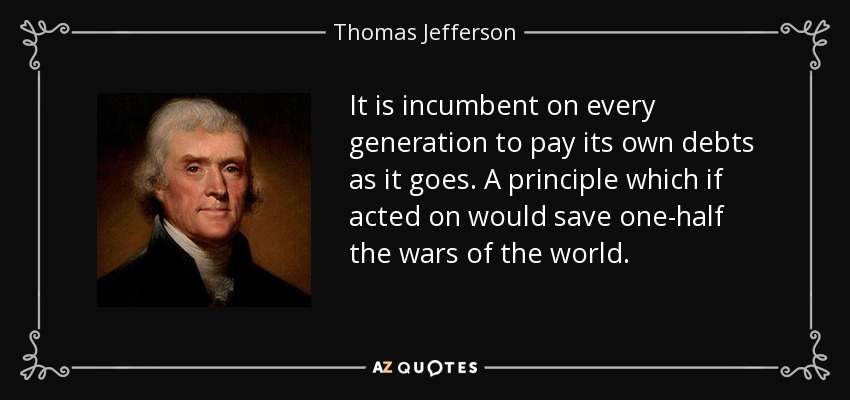
Four years later, in a letter to Destutt de Tracy, Jefferson sharpened the principle into a maxim:
And back in 1789, writing to James Madison, he framed it as a matter of intergenerational justice:
“No generation can contract debts greater than may be paid during the course of its own existence. … The 2d generation receives [the land] clear of the debts and incumbrances of the 1st. the 3d of the 2d. and so on.”
Jefferson’s insight was simple but profound: the earth and its fruits are entrusted to each generation for a season, not as collateral for endless chains of debt. His vision aligns far more with the biblical Jubilee than with the permanent mortgage-and-credit treadmill America has built.
Monticello’s scholars rightly flag the viral “banks and corporations own everything” quote as fake—but Jefferson’s authentic warnings cut even deeper. He saw that to bind the unborn to perpetual debt is not liberty but theft, a quiet war across generations.
5) How Inflation Picks Your Pocket (and the State Takes a Cut)
Even when the IRS indexes tax brackets, inflation still channels revenue through unindexed or partially indexed rules:
- Capital gains are taxed on nominal gains; your basis isn’t adjusted for inflation, so price-level increases are taxed as if they were real wealth.
- Bracket creep hasn’t vanished; the Congressional Budget Office still models “real bracket creep” lifting revenues relative to GDP over time.
- Property taxes rise when assessed values float up on comps; local budgets benefit from a debt-driven appraisal cycle.
Add it together and inflation behaves like a tax, even before you file in April.
6) Jubilee: God’s Counter-System
Leviticus 25 outlines a Jubilee year every fifty:
- Debts released,
- Land returned to ancestral stewards,
- Rest for land and people—a hard stop on perpetual extraction.
Jubilee breaks the compounding spell that converts human time into endless interest streams. It resets household balance sheets and re-anchors land as inheritance, not just a forever-levered commodity.
As America approaches 250 years—five cycles of fifty— the shofar will announce Jubilee on the Day of Atonement, October 1, 2025. The Jubilee year itself begins on 1 Aviv (April 17), 2026. If a nation refuses to release at the appointed time, history shows the alternative is not blessing but foreclosure—judgment at the scale of civilizations.
7) Field Guide: Spotting Debt-Capture in Your City
- Loan Availability → Price: Watch mortgage rates and credit standards. Prices follow credit like a shadow.
- Comps, not Costs: If every rehab sells with 95% LTV financing, the comps are credit-inflated.
- Investor Concentration: Track investor share in your county data or studies; look for rising bulk buyers in starter-home ZIP codes.
- Tax Drag: Before you sell, model nominal vs. real gains after inflation and taxes; the “win” may be thinner than it looks.
8) Tactics for the Remnant (Not Financial Advice—Battlecraft)
- De-leverage strategically. Kill unsecured high-interest first; avoid adjustable-rate traps.
- Buy like a steward, not a speculator. Favor livable-by-cashflow setups (house-hack, ADU, multigen).
- Fight appraisal with reality. When challenged, present better comps and repair evidence; don’t be passive with the lender.
- Consider land first. Prioritize productive land (food, water, heat security) over high-beta suburbia.
- Local covenants. Explore community land trusts or church-anchored stewardship models.
- Operate with margin. Aim for payment-to-income ratios that survive stress. If your plan only works in fantasy zero-rate land, it’s not a plan.
9) What We Should Say Out Loud
America’s money is born as debt; homes are priced by debt; and governments harvest inflation. None of that is neutral. It is a system design. Jubilee is not optional rhetoric—it is God’s design to stop the machine before the machine eats the people.
If this nation refuses release, the release will come anyway—by default, dispossession, and judgment. Better to proclaim liberty than have it torn from our hands.
Sources
- Bank of England (2014), Money creation in the modern economy: Link
- Federal Reserve History, Nixon Ends Convertibility of U.S. Dollars to Gold: Link
- U.S. Department of State, Nixon and the End of the Bretton Woods System: Link
- Fannie Mae Selling Guide, Appraisal Requirements: Link
- CBS News, Real estate investors are purchasing more U.S. homes as high prices lock out would-be buyers: Link
- Stateline (Pew Charitable Trusts), Investors Bought a Quarter of Homes Sold Last Year, Driving Up Rents: Link
- Monticello, Spurious Quotations — “Banks and corporations”: Link
- Congressional Budget Office, The Budget and Economic Outlook: 2025 to 2035: Link
- Tax Foundation, Capital Gains Taxes and Inflation: Link
Call to action: If you’re in a congregation or community willing to pilot Jubilee practices (debt release within the body, land stewardship covenants, benevolence funds that retire obligations), reach out. We’ll assemble a Jubilee playbook and publish case studies here.